Work OS · Reejig
Led an enterprise AI product from zero to one, as company ARR doubled
Work OS maps what people in a company actually do, task by task, then helps redesign that work with AI agents and prove what it saved. I was the sole PM leading its 0 → 1 launch.
- Role Senior Product Manager
- When October 2024 to January 2026
- Team Engineering, data science, design and customer success
Overview
A job description says a role exists. It doesn't say how the week is spent.
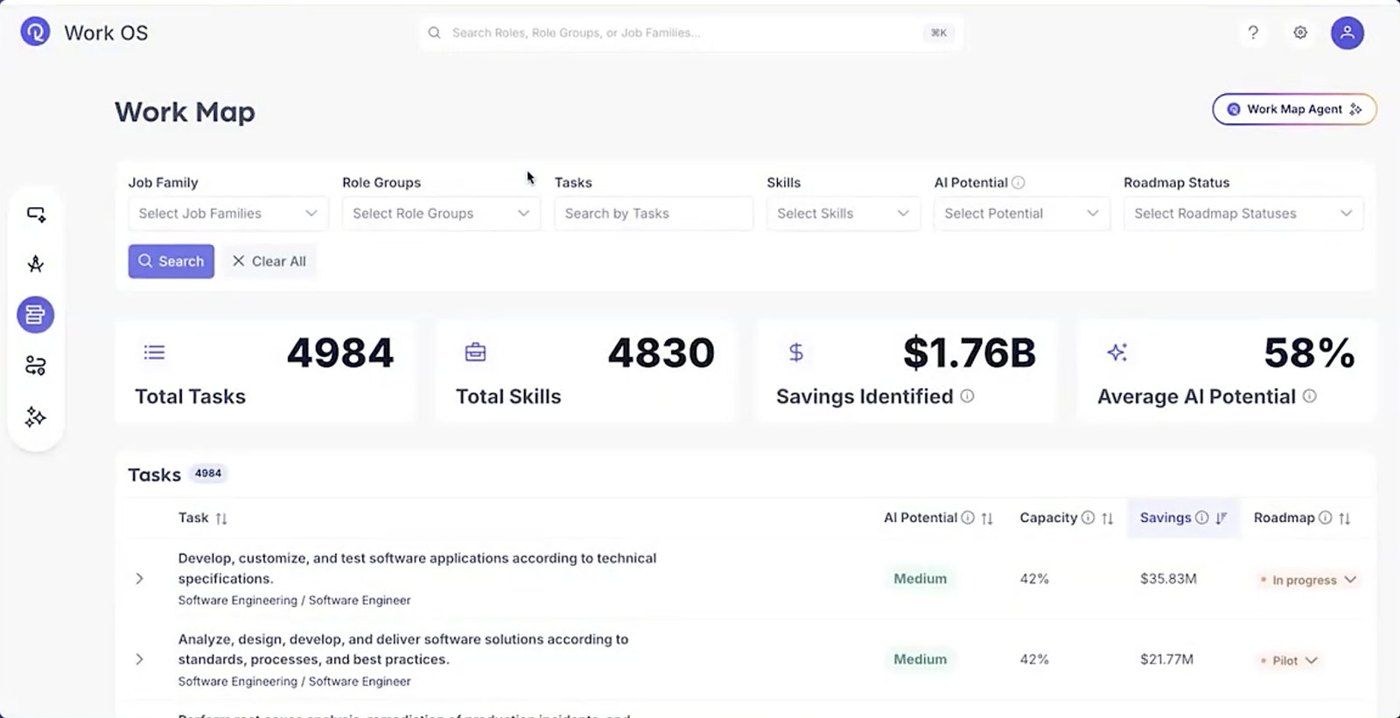
Enterprises were being told to adopt AI everywhere, with no way to see what their people actually did each day. Work OS models every role down to its tasks, estimates how much of each task AI could take on, and adds headcount and salary to show where time and cost are locked up. Then it helps teams redesign that work with AI agents, and measures the result.
I was its sole product manager, leading the 0 → 1 launch and reporting to the CPO. I owned its four layers end to end: seeing the work, deciding where AI helps, building with AI, and proving it.
By the time I left, sixteen enterprises were live on Work OS, including Walmart, Johnson & Johnson, UnitedHealth Group, IKEA, Micron, WPP, Dolby, HubSpot, Denso, Commonwealth Bank and Macquarie, and every new deal the company signed was a Work OS deal.
- Manage end-to-end recruitment activities
- Build strong relationships with stakeholders
- Support employer branding initiatives
- Other duties as required
The same demo role from the product, before and after. Not customer data.
Taking over
Two months from taking it over to enterprise launch
I was hired to run a different product, Career CoPilot. In April 2025 I moved onto Work OS to lead it. That same month I also covered the core HR app for four weeks while its product manager was on leave.
The first enterprise customer went live on 3 June 2025. By January 2026, sixteen paying customers were live, across financial services, retail, healthcare, technology, manufacturing, media and food production. Nine of them onboarded in October and November alone.
- Oct 2024Joined Reejig to run Career CoPilot
- Apr 2025Moved onto Work OS to lead it
- Jun 2025First enterprise customer live
- Oct–Nov 2025Nine customers onboarded, two large launches
- Jan 202616 customers live; builder tools shipped
Strategy
Four calls I made before building anything else
A zero-to-one product has more good ideas than people to build them. These were the calls that set the scope.
Foundations
I settled what would be expensive to undo before anyone built features
The first version assumed individual users and had no idea of a customer organisation. Any wrong call on tenancy or data ownership would be very hard to unwind later, so before feature work I wrote down the non-negotiables, set out two architectures with their trade-offs, and marked which decisions could be reversed and which couldn't.
The old product turned out to be the most useful input. It wasn't a blueprint. It was a map of what not to repeat: custom infrastructure for every customer had cost margin and speed, so Work OS started as one app, one database and one data set, with a dedicated environment as a paid upgrade once a customer needed it.
See the work
I rebuilt the product around the hierarchy HR already uses
Work OS launched as a flat list of roles, each with its own page. That isn't how job-architecture leaders think, and it isn't how the product was being sold. I added the levels they already use: the organisation, job families and role groups, each with its tasks and roles, and every number rolled up from the task.
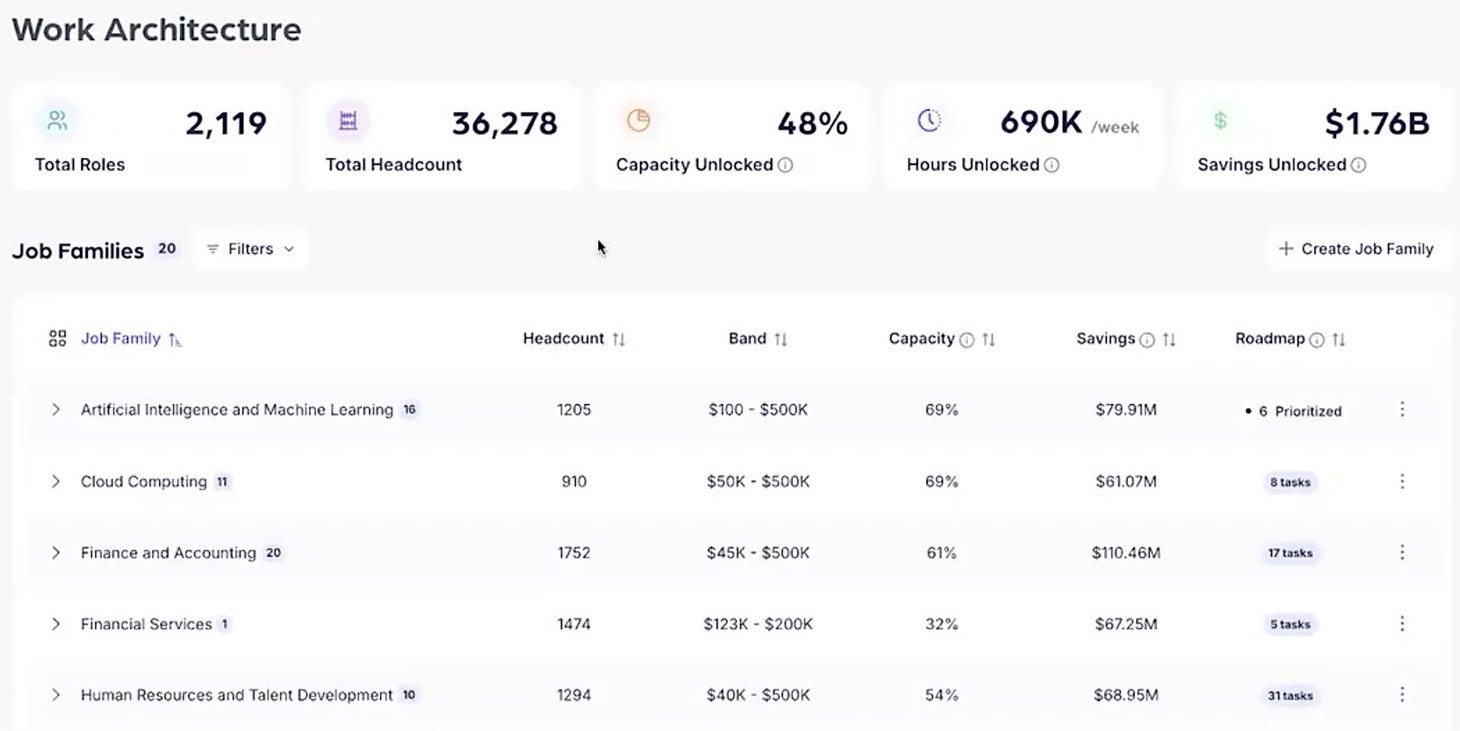
- Every number is computed at the task and rolled up, so the $1.76B is the sum of thousands of costed tasks.
- Each job family shows how much of its time AI could free up, and what that is worth.
- Tasks someone has committed to change are tracked on a roadmap, from prioritised to deployed.
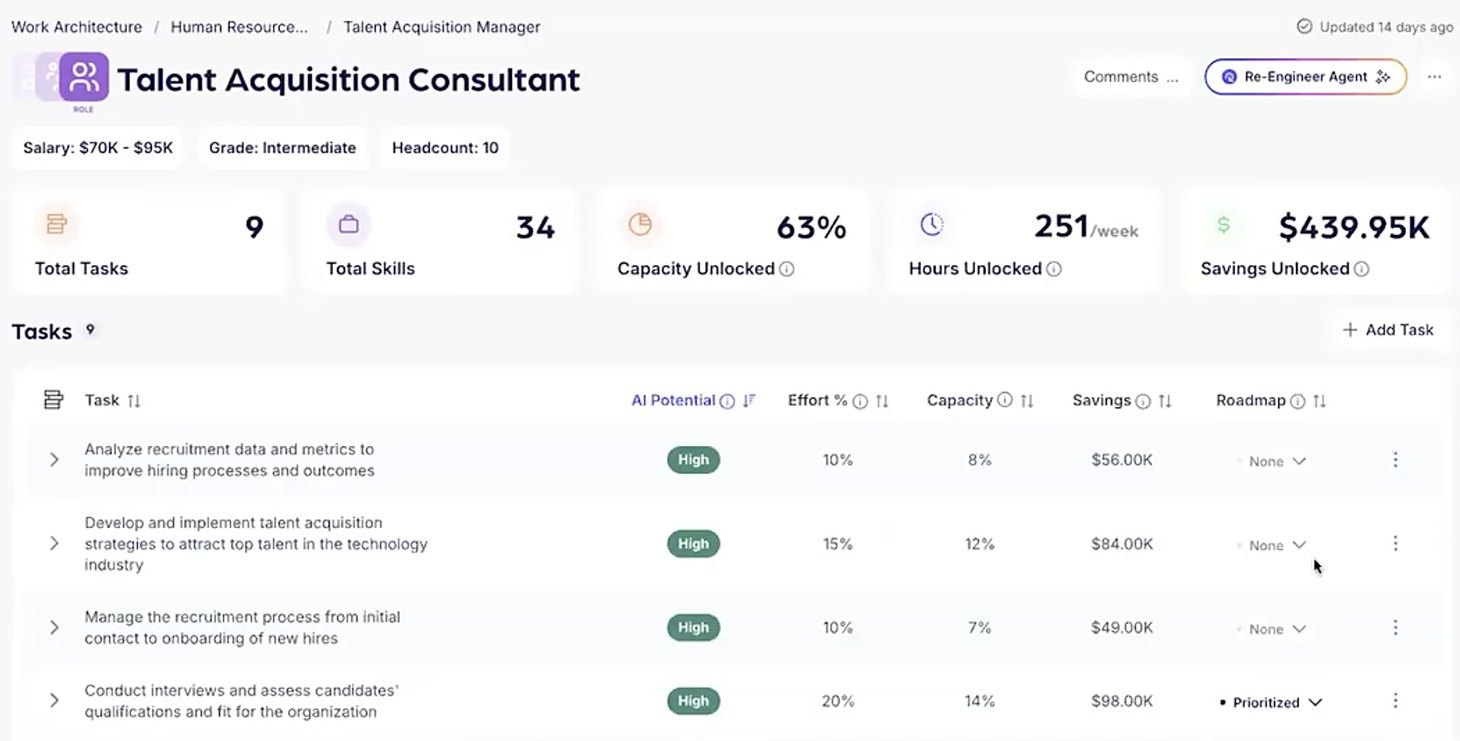
- One role: 63% of its time could be freed, worth about $440K a year across ten people.
- Each task gets its own AI potential, share of effort and savings. Customers confirmed over 90% of these task lists.
- From any role, the AI can be asked to redesign it.
Tables, not cards
The CPO wanted the card layout from the old product, for consistency. My designer and I looked at research on data-dense screens and at what our users actually did: they weren't browsing, they were scanning and comparing hundreds of roles and tasks. We took it to the CPO as a trade-off between consistency and faster, more accurate decisions, rather than a matter of taste.
Cards: the old product
To compare, the eye zigzags from card to card and holds each number in memory. Six fit on screen; customers had hundreds.
Table: what we shipped
The same values sit in one column. Sort it, and the priorities are the top rows.
The research is consistent about why. Nielsen Norman Group's guidance on data tables notes that two neighbouring values in a table can be compared without moving the eyes far or holding anything in memory, while cards make people reorient themselves every time they move from one card to the next. Its research on cards adds two costs that mattered here: cards take more space, so fewer fit on a screen, and they play down ranking, which is exactly what a prioritisation screen needs to show.
Tables also support the four jobs people do with this kind of data: find the records that match a criterion, compare them, look at or edit one row, and act on several at once. Cards are better for browsing a handful of varied items, which wasn't what anyone came to Work OS to do.
We shipped tables, and session replays later showed people sorting columns and prioritising exactly as designed.
I checked our own numbers before customers saw them
The Work Intelligence page gives an executive a one-screen answer, with a written formula behind every headline. Before it shipped I challenged the figures that didn't hold up, such as "AI returns value in 1 month" (too fast) and "99% of roles impacted" (too much). A number an executive can't defend in front of a board is worse than no number.
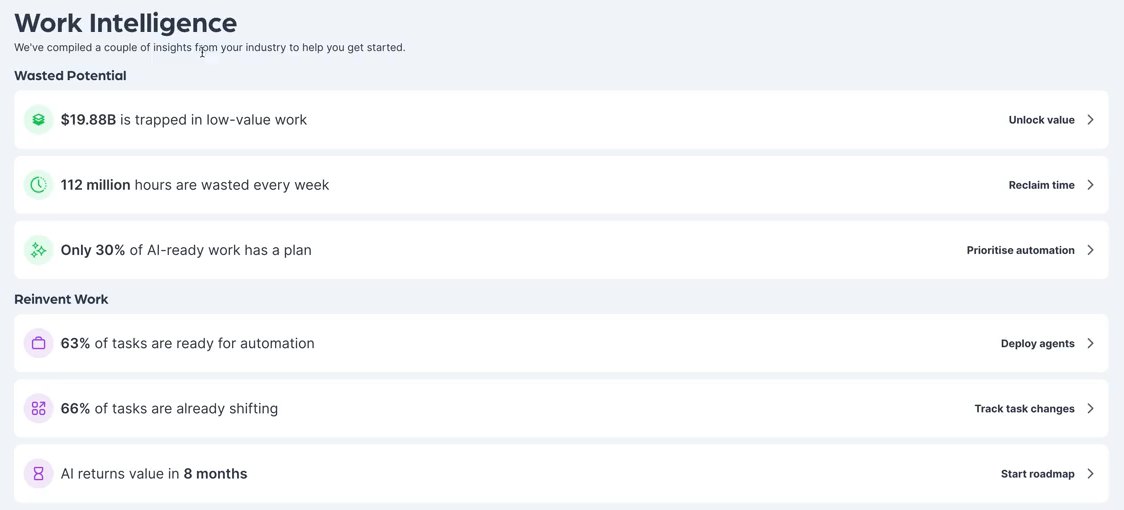
- Findings in plain sentences, each one linked to the page where you can act on it.
The first HR-system integration
SAP SuccessFactors maps roles to skills but has no idea of tasks. We positioned Work OS as the intelligence layer inside SAP rather than another silo. With an HR system of record, the hard part isn't the API. It's earning enough trust to write to it.
Behind every number is a small set of data rules. Getting them right is what let one task be shared by many roles without its savings being counted twice.
- A role group belongs to one job family.
- A role belongs to one role group.
- A task belongs to one role group, but can be done by many of its roles.
- Skills are shared across everything.
Decide
One slow answer became a choice of three
Every task and role has questions built in: how can AI help with this task, how should this role change, where is the biggest opportunity. I designed those flows before any were built, tagging every branch by what it costs to answer: a database lookup, a model call, or both. Some "conversations" were really lookups in disguise, and paying for a model to restate a known fact is slower and less accurate.
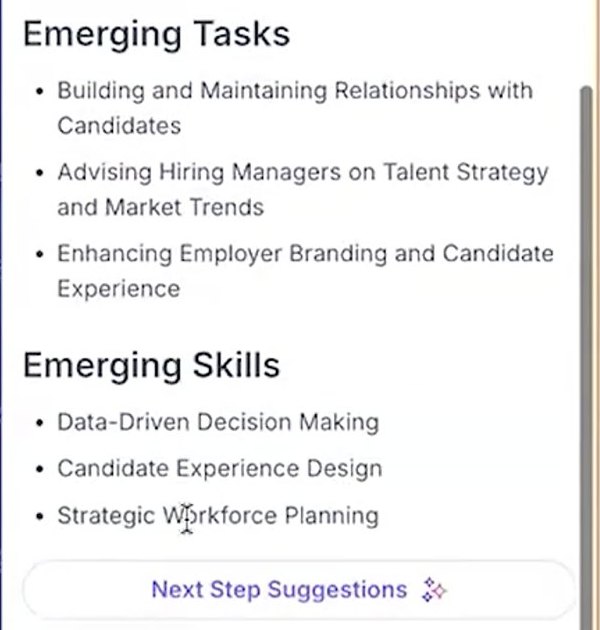
The biggest fix was the re-engineer flow. It used to bundle three kinds of answer into one long, slow response. Now it asks which one you want, and generates only that.
Nothing to look up: this work doesn't exist yet.
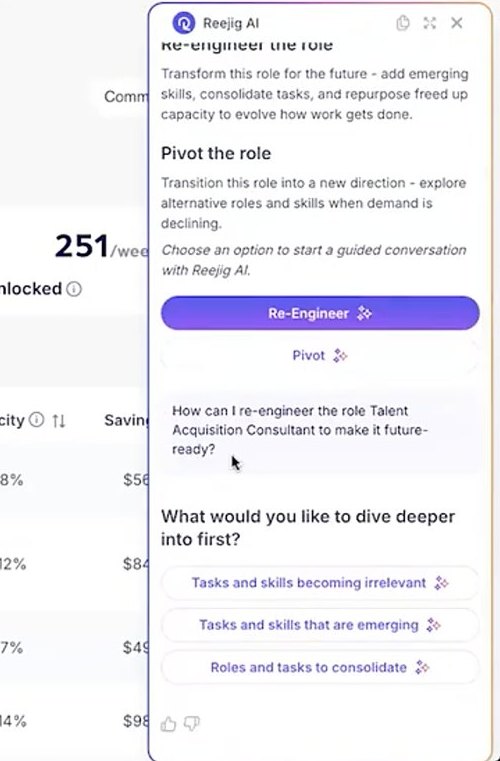
- Two directions for the role: re-engineer it, or pivot it.
- Three paths. Only the chosen one is generated.
Build
AI takes over one step at a time. A person always signs off.
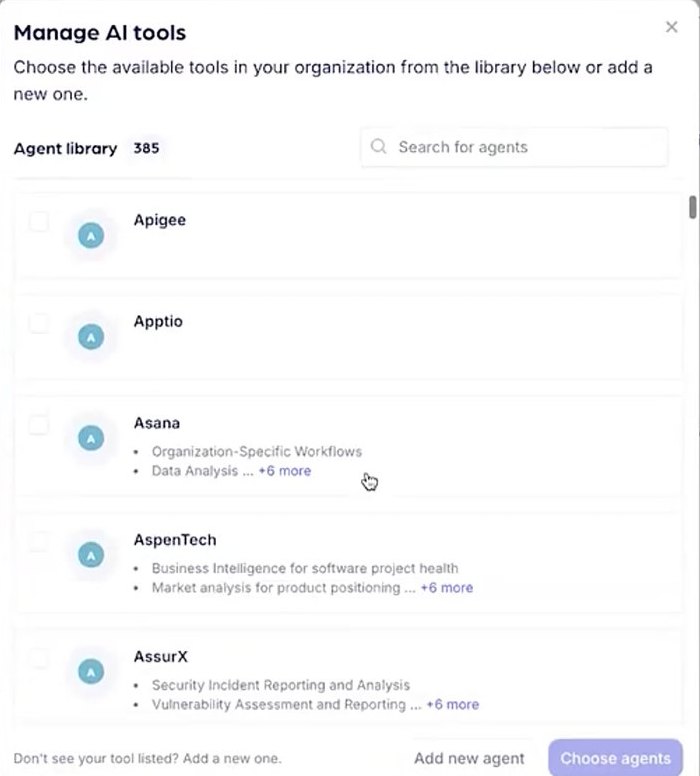
Clicking "Re-invent" on a task opens a workflow drafted by the model: the steps, what each produces, a suggested agent for each step, and the time it takes. A builder edits it, adds real times, picks agents and publishes. The model never has the last word.
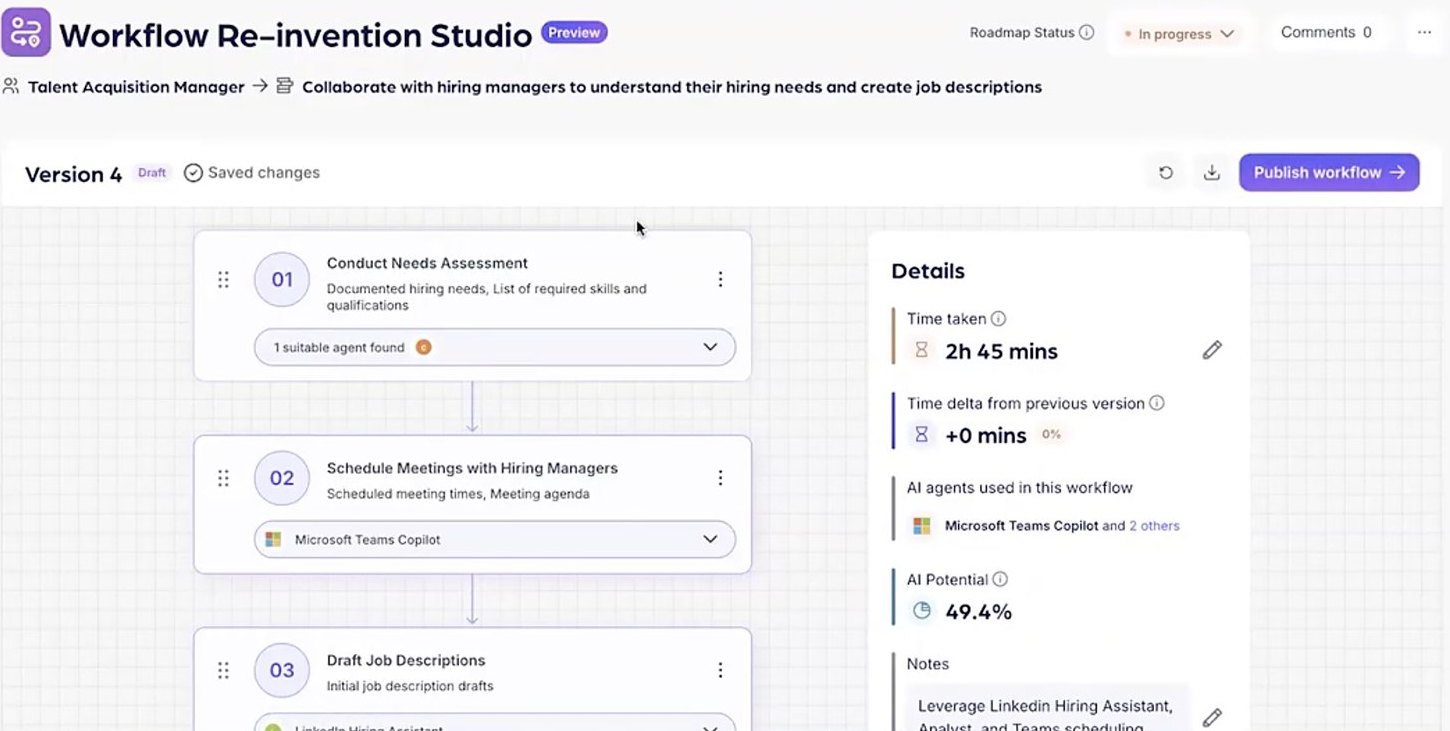
- Each step gets its own suggested agent, from the tools the customer already owns.
- Time taken and the change from the last version, so savings are measured, not claimed.
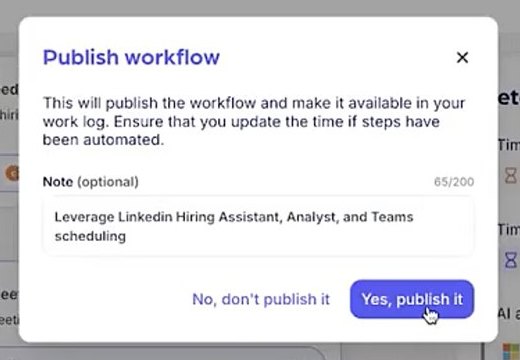
- Nothing goes live until a person publishes it.
Prove
Without proof, AI transformation is a pile of anecdotes
HR and transformation leaders put these savings in front of their boards. Two surfaces hold the proof: a log of every workflow that was redesigned, and one screen for every AI agent in the company.
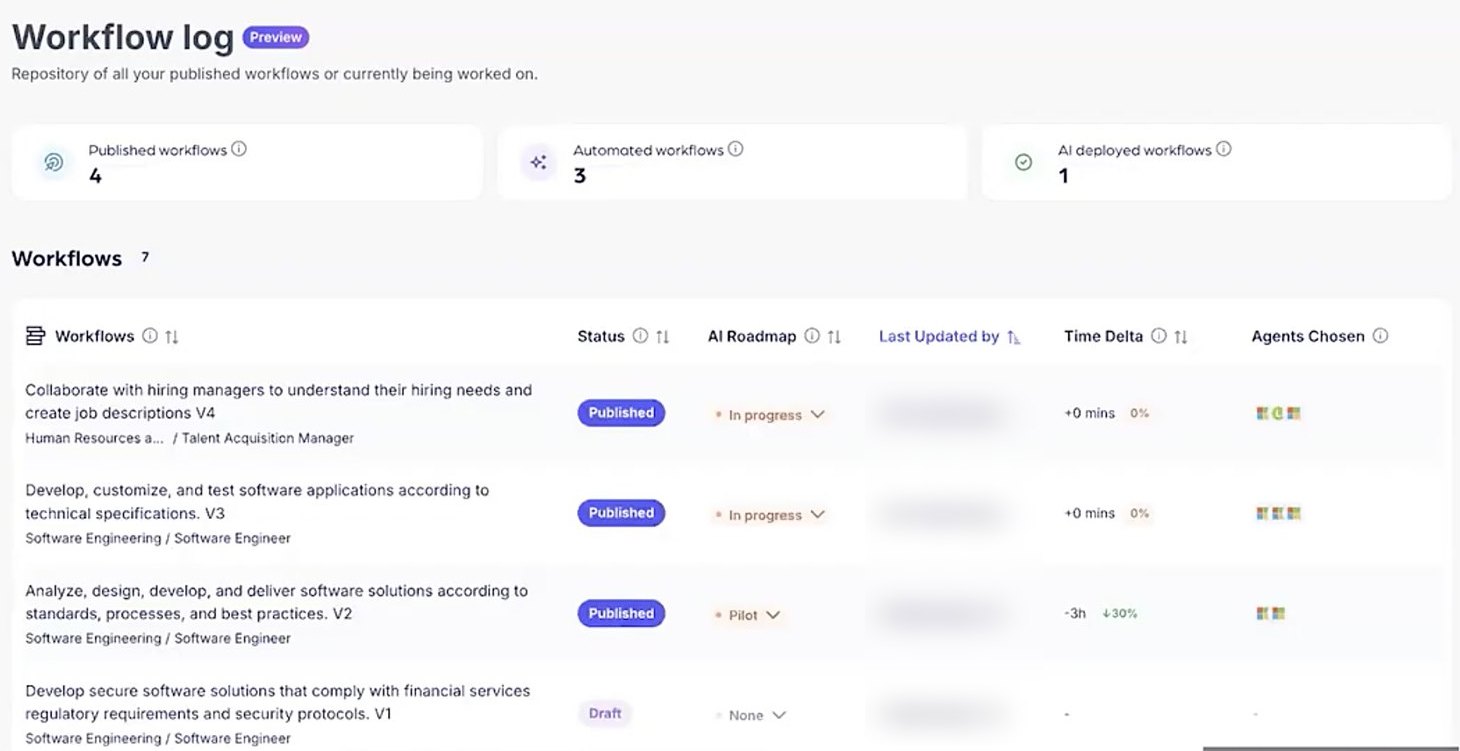
- Designed and delivering are counted separately. Leadership needs to know the difference.
- Every published version, with who updated it.
- The time saved per run, here three hours, or 30%.
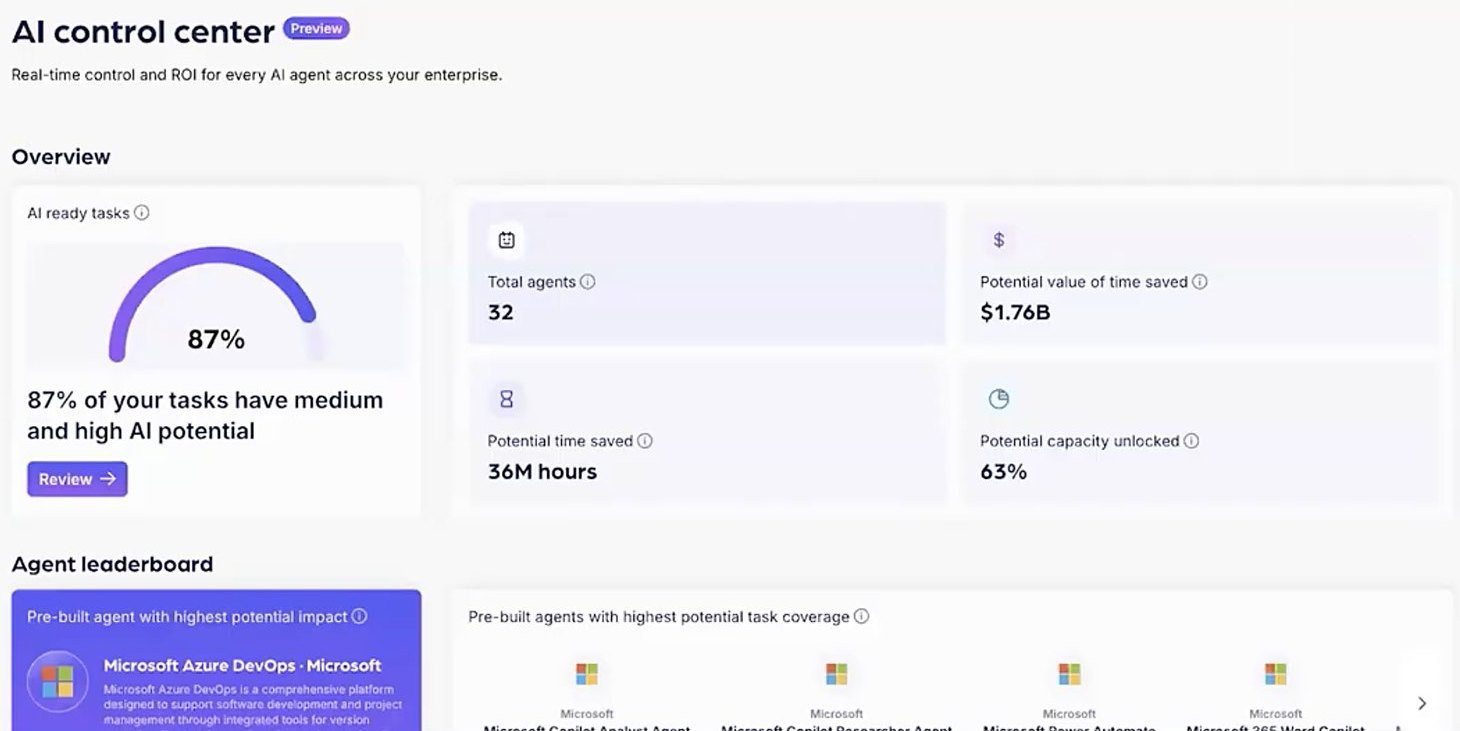
- How much of the organisation's work AI could take on.
- What that time is worth, which is the number executives act on.
- Agents ranked by their potential impact on this organisation's tasks.
Keeping the savings number honest
Time saved per run is the flattering number. How many people use the workflow, and how many of them choose the AI version, make it honest.
Judgement
The calls that didn't land the first time
Shipping AI output to companies making workforce decisions forced precision about what "good enough" means.
I held the launch of the builder tools for a week
The December bug bash showed launch blockers still open, and AI output nobody had reviewed. The team had the capacity to clear the blockers, so I recommended we push delivery by a week to review output quality and plan how customers would be introduced to it. The riskiest assumption wasn't whether it worked. It was whether customers would trust the numbers, and a trust problem is not something a later fix undoes. The studio, the log and the control centre were all live before I left.
Where the threshold for a recommendation should sit
Engineering and I had set a 50% confidence threshold for suggesting an AI agent. Walking the product the way a customer would before a rollout, I kept hitting empty recommendation panels, and an empty panel reads as broken. Our Head of Data and I agreed quickly that 50% was too strict. We disagreed on how far to come down: I wanted 30%, he wanted 25%. We settled it with the actual distribution of match scores, which supported 25%, further than I was comfortable with. I committed on one condition: we monitored how many recommendations each customer saw, and treated 25% as a starting point to tune, not a settled answer.
Demo scores were twice what real data produced
Those scores feed the savings shown to executives, so they had to be checked against real data before anyone saw a dollar figure. We also debated hiding AI potential from the workflow shared with employees. We kept it in. Being open that a task should be automated, and that it frees time for more human work, built more trust than hiding it.
On-demand answers were too slow, so I changed the architecture and the onboarding order
Agent recommendations were first generated the moment someone clicked, then cached. Testing on real customer data, I saw people waiting at exactly the moment they needed an answer. We moved to computing them in the background before customers arrived, keeping on-demand only for new or edited tasks. That front-loaded heavy processing for every new customer onto a small data team, so I worked with customer success to change the order customers went live in. A slightly adjusted rollout cost far less than a bad first impression. I'd now test that assumption against realistic data volumes before building, not after.
I used the holidays to pay down debt
Engineering was flagging that every feature took longer than it should. The CPO wanted to push through the holidays to stay ahead of new customers. I didn't argue for code quality. I argued for speed: the debt was compounding, and the holidays were the cheapest window we'd get for six months. He agreed. The team came back in January moving faster, and the onboarding we were protecting landed on schedule.
I argued against subtasks, and I was wrong
I recommended a flatter data model without subtasks, because they added complexity for the model and cut against how it reasons. The CEO had a strong vision for workflows at the subtask level, and sales saw it as a strong concept. We shipped subtasks. They became the level customers most wanted to control. A simpler model for the AI isn't automatically more valuable to the customer.
Adoption
With per-role pricing, a few people decide every renewal
Each account had a handful of senior users, so I ran adoption account by account. The weekly report started as a raw count, "e.g. X customers engaged", and I turned it into a rate with a stated denominator, "X of 16, Y% active", that could be compared week to week. Quiet accounts were split into our bottlenecks and theirs, and the one getting quieter each week got attention first.
Launching that largest customer meant three blockers: making pages and roll-ups hold up at that scale, working with their IT team to allow our domain, and shipping comments on roles and workflows, which they had asked for. Comments helped every customer, so I brought them forward.
What people leave alone, the AI has earned. What they change stays with people.Session replays showed customers barely edited the AI's task lists, but heavily edited the steps inside each task. That became my rule for autonomy: ship the control, and watch what gets overridden.
Measurement
Sixteen metrics, four of them critical
I built the framework reported monthly to leadership and investors, in three groups: the value of the work data, the impact of engagement, and product health. Four metrics were marked critical: essential to the product's survival, not just to the story. Trends used a rolling 28 days, because investors read trends and a rolling window doesn't swing when a month has more weekends.
| Group | Metric | What it shows |
|---|---|---|
| Value of the work data | Unique tasks modelled Critical | Visibility of work at scale, before any AI usage |
| Data validation accuracy | Quality, confirmed by business leaders | |
| Weekly hours and annual dollars unlocked | Potential value before anyone acts | |
| Impact of engagement | Workspaces using the AI agent Critical | The AI is used, not just the screens |
| High-potential tasks put on a roadmap | Insight turned into action | |
| Hours and dollars from roadmapped tasks | Impact customers committed to | |
| Product health | Stickiness Critical | A recurring part of customers' work |
| Time to first core action | Time to value | |
| Net promoter score Critical | Advocacy |
Nine of the 16 metrics.
Reflection
Trust is earned one layer at a time
The lesson I keep coming back to is that enterprise AI is adopted in layers. Customers trusted the AI's map of their work almost immediately, and wanted control over the steps inside it. The product worked because it showed its sources, let people overrule it, and measured what actually changed.
What I'd do differently: we checked AI output by hand, with ratings and logs of accepted and rejected suggestions. An automated grader doesn't need a known right answer to catch invented skills, answers that stray from their context, or regressions when a prompt changes. Only one judgement really needs a person: whether a restructuring is right for that organisation. I would automate the rest from the start.
I'd also have retired one metric sooner. An early "AI impact" score averaged across roles and ignored headcount, so a one-person role counted as much as a 200-person one. A metric that ignores who does the work can't justify a headcount decision.